

NASEEM
Sector
Private
Location
Dubai, UAE
Year
2025
Design Team
Abdallah Zaidan
Rooted in the climate, culture, and materiality of the UAE, this proposal for the House of the Future reimagines the home as a climate-conscious sanctuary; a structure that lives in harmony with its environment rather than shielding itself from it. At its core are two courtyards: a public-facing entry garden that welcomes guests and a private inner sanctuary reserved for family life. These courtyards are not ornamental—they are climatic engines that drive passive cooling, daylighting, and spatial organization. The architecture is composed of slender, cross-ventilated volumes with double exposure, allowing air to move freely and naturally through the home. With a sensitive balance of openness and privacy, the house embraces sunlight, airflow, and vegetation while protecting its inhabitants from harsh environmental conditions. It is a vision for future living in the desert—climate-responsive, materially honest, and spatially generous.


Passive Systems: Designing with the Desert
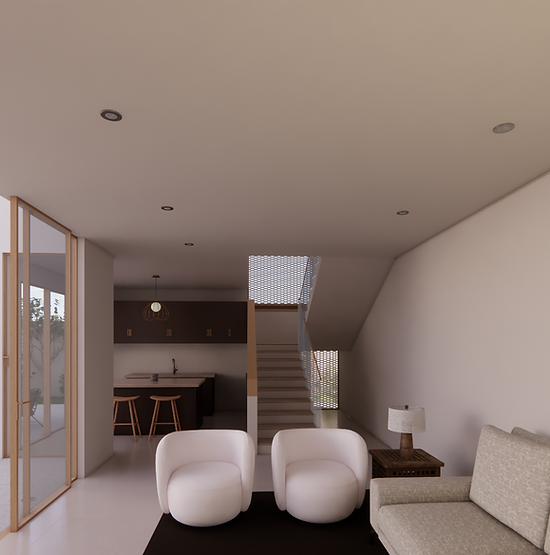
Throughout the home, architectural screens inspired by traditional mashrabiya are deployed as performance driven devices. Placed strategically on upper floor openings, they encourage stack ventilation, drawing hot air upward and releasing it while enabling cooler air to enter low. These breathable boundaries blur the line between interior and exterior while shielding against direct sunlight.
All spaces are oriented and proportioned for maximum airflow and minimal solar gain. The private courtyard faces the North allowing for soft light to fill the space. Deep reveals invite sunlight only where it benefits the user. Vegetation in both courtyards acts as a microclimate engine, contributing evapotranspiration that cools the air before it enters interior rooms.

Privacy and Threshold: Veiled Entry
The home addresses the street with a quiet, dignified frontage, one that obscures direct views into the entry sequence. A perimeter wall at the front defines the guest facing courtyard while partially screening the front door, reinforcing a sense of privacy and gradual arrival. This gesture reflects traditional architectural strategies in the region, where the home unfolds as a journey of thresholds rather than an immediate reveal.
The separation between street and sanctuary allows the front courtyard to function as a transitional buffer, mediating scale and temperature while inviting guests into a space that is open but protected.


Spatial Strategy: Architecture and Airflow
The design of the home centers on the idea of porous living, a home that breathes with the desert rather than shielding itself from it. The plan is anchored by two courtyards: a public-facing front courtyard that welcomes guests and a private rear courtyard that belongs solely to the family. These dual courtyards not only reinforce traditional spatial hierarchies in Gulf domestic culture but also act as climatic filters, encouraging airflow across the depth of the house.
Rather than a singular mass, the home is broken down into a sequence of narrow volumes, each interspersed by light wells, breezeways, and voids that invite cross ventilation. Each room is designed with double exposure, enabling fresh air to passively cool interior spaces throughout the day. This thinness of space—paired with the use of stack-effect-driven screening devices—eliminates reliance on mechanical cooling for most of the year.


